
Industrial Extension Springs: A Technical Guide to Design and Application
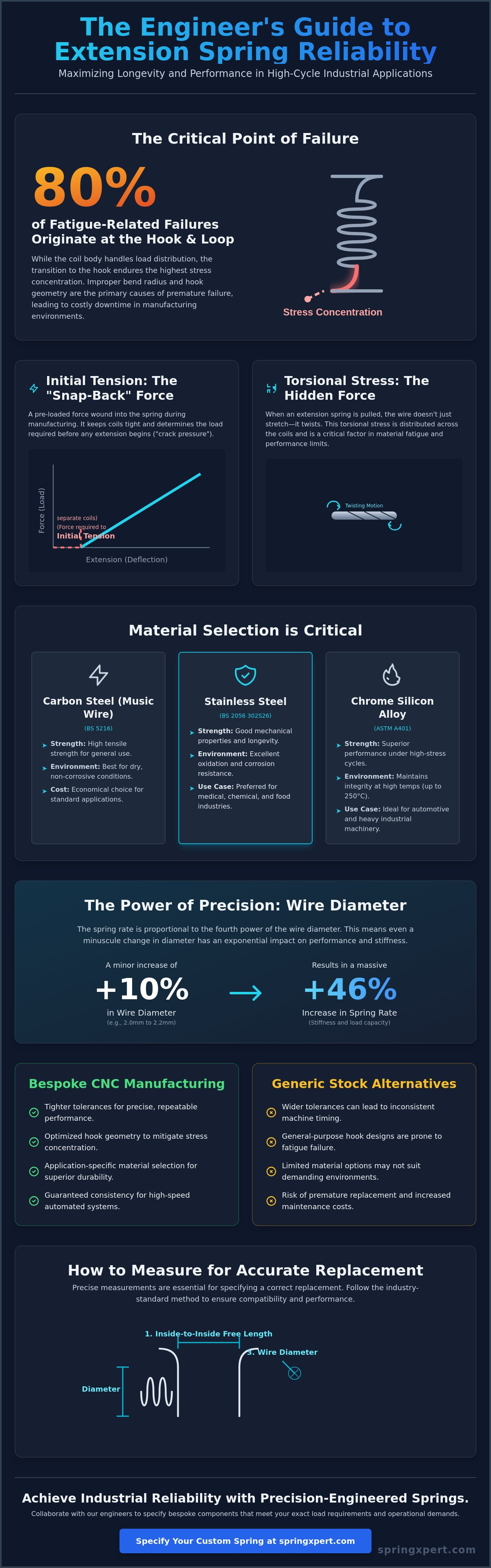
Over 80% of fatigue-related failures in industrial extension springs originate at the cross-over loop rather than the coil body. This critical stress concentration often results from improper hook geometry or a lack of consideration for the bend radius during the design phase. You've likely experienced the frustration of inconsistent initial tension affecting machine timing or the difficulty of measuring a deformed spring for an urgent replacement. In high-speed UK manufacturing environments, these minor deviations in spring rate lead to significant downtime and increased maintenance costs.
At SpringXpert, we believe precision is the only path to industrial reliability. This guide provides an engineering breakdown of extension spring mechanics, material selection, and end-loop configurations to maximise component longevity. We'll examine the physics of tensile strength and alloy performance to help you specify bespoke springs for high-cycle applications. We'll also cover the precise measurement techniques needed to document used components accurately. This technical overview ensures your next specification meets the strict tolerances required for your specific industrial requirements and operational stability.
Key Takeaways
- Analyze the fundamental mechanics of initial tension and the critical impact of torsional stress on material performance in high-tensile applications.
- Identify why hook and loop geometry is the primary failure point and how to optimize radius specifications to mitigate stress concentrations.
- Master the industry-standard method for measuring extension springs to ensure accurate replacement through precise inside-to-inside free length calculations.
- Evaluate the technical advantages of bespoke CNC-manufactured components over generic stock alternatives for achieving tighter tolerances and superior durability.
Understanding Extension Springs: Mechanics and Initial Tension
Extension springs are fundamental mechanical components designed to store and absorb energy by resisting a pulling force. Unlike compression springs, which operate by pushing coils together, these units function through axial tension. When a load is applied, the coils separate; once the load is removed, the spring attempts to return to its original length. Engineers specify extension springs for applications where a precise return force or consistent tension is required to maintain system equilibrium.
The defining characteristic of these components is initial tension. This internal force is created during the manufacturing process by winding the wire tightly against itself. It's the reason the coils remain in contact when the spring is in a relaxed state. The magnitude of this tension determines the "snap back" force. A spring with high initial tension requires a specific amount of force before any physical separation of the coils occurs. This ensures the component remains rigid and functional within high-vibration industrial environments.
The Physics of Tension: How They Store Energy
The performance of extension springs follows Hooke’s Law, which states that the force required to extend a spring is proportional to the distance it's stretched. However, the force-deflection curve for these springs doesn't start at the origin. Because of initial tension, the graph begins at a predetermined load point. This is often called "crack pressure." It represents the exact load required to overcome the internal tension and begin coil separation. In precision manufacturing, calculating this value is vital for ensuring the spring engages at the correct threshold within a mechanical assembly.
Common Industrial Applications
In the UK industrial sector, these components are essential for various heavy-duty and high-precision systems. Common applications include:
- Heavy Machinery: Return mechanisms in hydraulic systems and automotive brake assemblies rely on the repeatable resistive force of these springs.
- Tensioning Systems: Industrial conveyor belts and large-scale garage doors use them to maintain belt alignment and counterbalance weight.
- Medical Technology: Small-scale, custom-engineered springs provide precise resistance in surgical tools and diagnostic equipment, where 0.1mm tolerances are standard.
SpringXpert provides bespoke solutions for these complex requirements. Our engineering team focuses on material integrity and precise initial tension to meet British manufacturing standards. We invite technical collaboration to ensure your specific load requirements are met with industrial reliability and technical depth.
Material Science and Torsional Stress in Extension Design
The mechanical integrity of extension springs relies on the precise management of torsional stress within the wire. As the component extends, the wire doesn't simply stretch; it undergoes a twisting motion across its entire length. This stress is distributed throughout the active coils, but it's often concentrated at the transition points between the body and the end fittings. Material selection is more critical for these components than for compression forms because extension springs frequently operate under constant initial tension, leaving less margin for material fatigue or yield.
Standard carbon steel, commonly specified as Music Wire (BS 5216), provides high tensile strength and is suitable for dry, non-corrosive environments. However, stainless steel remains the preferred choice for applications requiring longevity in volatile conditions. Wire diameter plays a decisive role in performance; the spring rate (k) is proportional to the fourth power of the wire diameter. A small shift from a 2.0mm to a 2.2mm wire diameter results in a 46% increase in the spring rate. This relationship dictates the maximum safe extension and ensures the spring doesn't exceed its elastic limit during operation.
High-Performance Alloys for Industrial Use
For the UK chemical and medical sectors, BS 2056 302S26 stainless steel is the standard specification. It offers excellent resistance to oxidation and maintains mechanical properties in moderately acidic environments. When applications involve extreme temperatures or high-stress cycles, Chrome Silicon (ASTM A401) is the superior choice. This alloy maintains its structural integrity at temperatures reaching 250°C. Surface finishes like zinc plating or passivating aren't just aesthetic; they provide essential protection against galvanic corrosion, often doubling the component's life in harsh environments.
Managing Fatigue and Cycle Life
Stress levels within the body coils differ significantly from the stresses found at the hooks. While the coils primarily experience torsion, the hooks are subjected to intense bending and tensile forces. This disparity makes the hook geometry the most frequent site for fatigue failure in extension springs. The fatigue limit is the maximum stress level a material can withstand for a specified number of cycles without failing. Engineers use torsional stress calculations to predict these failure points before production begins. For high-cycle applications, seeking a custom-engineered solution helps ensure that the chosen alloy and hook design can withstand the calculated loads without premature fracture.
Hook and Loop Configurations: Engineering the Connection
In mechanical design, the hook is the most common point of failure for extension springs. This vulnerability isn't accidental; it's a direct result of stress concentration. When a spring extends, the stress at the bend of the hook can be up to 2.5 times higher than the stress in the spring body. This disparity occurs because the hook experiences both tensile and bending stresses simultaneously. Engineers must calculate the stress concentration factor, often referred to as the K factor, to ensure the hook can withstand the operational load without plastic deformation.
Standard end types cater to specific industrial mounting requirements. German loops, or full loops, provide a secure connection with high reliability in heavy-duty applications. English loops are essentially half-loops and are used where a simpler attachment is sufficient. Side loops are formed from the side of the spring body, allowing for offset mounting. For complex industrial machinery, bespoke end configurations are often required. These custom-engineered solutions might involve threaded inserts or specialized geometry to interface with unique housing units found in UK manufacturing plants.
Comparing Standard End Types
Choosing between machine loops and crossover loops depends on your alignment needs. Machine loops are formed directly from the last coil, whereas crossover loops are pulled across the centre of the spring. Crossover loops offer superior axial alignment, reducing the risk of eccentric loading. Extended hooks provide a solution when anchor points are distant from the spring body, often reaching lengths of 50mm or more. Swivel hooks are a premium option; they rotate freely to eliminate torque during extension, preventing the spring from buckling under torsional stress.
Designing for Hook Durability
To prevent micro-fractures during the forming process, the internal bend radius of a hook should never be less than 1.5 times the wire diameter. Smaller radii create brittle points that fail prematurely under cyclic loading. Specification must also include the hook gap and relative position. Hooks are typically specified at 0, 90, or 180-degree orientations to ensure they align with the mounting pins. If your application's space constraints are too tight to accommodate standard hooks, consider using disc springs as an alternative solution. These components provide high force in minimal axial space where traditional extension springs cannot fit. Precision in these specifications ensures the component meets the rigorous safety standards required in British industrial environments.
Measuring and Calculating Extension Spring Specifications
Accurate measurement of extension springs ensures mechanical assemblies maintain their intended tension and fatigue life. When a component fails in an industrial setting, replacing it with an identical specification is critical to prevent system-wide imbalances. Technicians must use precision digital calipers for all dimensions, as even a 0.1mm variance in wire diameter can significantly alter the spring rate.
Free length is the most vital measurement for fitment. It's defined as the distance from the inside of one hook to the inside of the opposite hook, rather than the total overall length. You should also record the body length, which is the total length of the coiled section excluding the hooks. This distinction ensures the spring fits within the available spatial envelope without premature stretching during installation.
A Step-by-Step Measurement Guide
- Step 1: Measure wire diameter (d). Take measurements across several coils using calipers to account for any coating or slight wear. Use the average of these readings to ensure your data reflects the original manufacturing intent.
- Step 2: Calculate Mean Diameter (D). Measure the Outside Diameter (OD) of the spring body. Subtract one wire diameter (d) from the OD to find the mean diameter (D = OD - d). This value is essential for accurate torque and stress calculations.
- Step 3: Count active coils (n). In most extension springs, the active coils are equal to the total number of coils in the body. This count directly determines the stiffness and flexibility of the component.
Using Formulas for Custom Specification
Calculating the Spring Rate (k), measured in N/mm, allows engineers to predict how much force is required to extend the spring a specific distance. The standard formula is k = (G * d^4) / (8 * D^3 * n). The value for G, the shear modulus, varies by material. For standard UK carbon steel (BS EN 10270-1), G is typically 79,300 MPa, while stainless steel 302/304 (BS EN 10270-3) uses a lower value of approximately 68,500 MPa.
You must also verify the maximum extended length to prevent permanent deformation. If a spring is stretched beyond its elastic limit, it won't return to its original free length. Industrial designs typically limit extension to 85% of the maximum safe travel to ensure longevity and reliability. Our technical team provides detailed analysis to confirm these tolerances before production begins, ensuring your components withstand high-cycle environments.
If your application requires a bespoke solution with precise load characteristics, contact our engineers for a custom extension spring consultation today.
Bespoke Manufacturing and Quality Standards at SpringXpert
Custom-engineered extension springs provide a significant performance advantage over generic stock components. While off-the-shelf parts are accessible, they rarely align perfectly with specific load-at-length requirements or unique spatial constraints. SpringXpert utilizes multi-axis CNC technology to maintain exact control over initial tension and hook forming. This automation eliminates the variability found in manual processes. It ensures every unit in a high-volume run matches the master specification, whether you require 500 or 50,000 components.
Our production facility adheres to BS 1726 Class B tolerances as a baseline for industrial reliability. This standard governs the permissible variations in free length, spring rate, and load, providing the precision necessary for heavy-duty machinery and safety-critical systems. The collaborative design process begins with your CAD drawings or technical sketches. We bridge the gap between conceptual engineering and physical production, moving rapidly from initial prototypes to full-scale manufacturing within established UK lead times.
Quality Assurance and Technical Testing
Reliability is verified through rigorous load testing protocols. We use calibrated digital testers to measure initial tension and spring rate accuracy, ensuring the component performs as predicted under operational stress. For regulated industries such as Aerospace and Medical manufacturing, we provide full material traceability and EN 10204 3.1 certification. This documentation confirms the chemical composition and tensile strength of the alloy used. We also specialise in prototyping non-standard wire forms for UK manufacturers, allowing for the testing of complex geometries before committing to large-scale production runs.
Specifying Your Requirements
To generate an accurate technical quote, our engineering team requires specific data points that define the spring’s working life. You should provide the required load at a specific extended length, the total number of coils, and the desired hook configuration. Environmental factors are equally critical; we assist in selecting materials like 316 stainless steel for corrosive marine settings or Inconel for high-temperature applications. Our engineers don't just take orders; they consult on wire diameter and mean coil diameter to optimise the fatigue life of your bespoke design.
Efficient production starts with technical clarity. Contact SpringXpert for a technical consultation on your extension spring requirements.
Advancing Industrial Systems with Technical Precision
Designing high-performance industrial components requires a calculated balance between initial tension, material selection, and end-loop geometry. Selecting the correct alloy is vital to manage torsional stress and ensure longevity in demanding UK environments. Accurate calculations of spring rate and load tolerances prevent premature failure in critical mechanical assemblies. At SpringXpert, we leverage over 20 years of engineering expertise to manufacture parts that meet rigorous ISO-aligned quality control standards. Our team sources specialist materials to ensure every bespoke solution performs reliably under specific load requirements. Whether you're refining a prototype or scaling production, technical precision remains the foundation of operational success. We invite you to explore our range of bespoke extension springs and technical services to see how our manufacturing capabilities support your engineering goals. We're ready to help you solve your most complex spring design challenges.
Frequently Asked Questions
What is the difference between an extension spring and a tension spring?
An extension spring and a tension spring are functionally the same component; the terms are used interchangeably within the UK manufacturing sector. Both designs store energy by resisting a pulling force and are wound with initial tension to keep the coils closed. In technical specifications, these springs are defined by their ability to return to a predetermined length after the external load is removed.
How do I calculate the initial tension of an extension spring?
You calculate initial tension by determining the specific load required to overcome the internal force holding the coils together. To find this value, apply a load and measure the extension, then apply a second, larger load and measure the change. Subtract the product of the spring rate and the first extension from the first load. This internal force typically accounts for 10% to 15% of the total load capacity in standard industrial applications.
Why do extension spring hooks often break, and how can I prevent it?
Hooks fail because they experience 25% to 30% higher stress levels than the spring body, particularly at the transition radius. You can prevent these failures by specifying a larger bend radius or using threaded inserts instead of traditional loops. At SpringXpert, we recommend keeping the operating stress below 75% of the material's tensile strength to ensure the longevity of extension springs in high-cycle environments.
What is the maximum extension a spring can safely achieve?
The safe maximum extension is generally 85% of the spring's elastic limit. If you stretch the component beyond this point, the wire undergoes permanent deformation and won't return to its original free length. Engineers must verify the maximum safe travel by referencing the wire's British Standard (BS EN 10270) grade to avoid premature fatigue or catastrophic failure under load.
Can extension springs be used in high-temperature environments?
Yes, provided you select high-performance alloys like Inconel X750 or 316 Stainless Steel which operate effectively above 250°C. Standard carbon steels lose their structural integrity and tensile strength once temperatures exceed 120°C. For specialist UK aerospace or automotive applications reaching 400°C, we provide custom-engineered extension springs using cobalt-based alloys to maintain precise tension and performance standards.
How do I measure the free length of an extension spring accurately?
You measure the free length by calculating the distance between the inside bearing points of the two hooks. It's a common mistake to measure the total end-to-end length, but the bearing points are what define the functional fit within an assembly. Use digital calipers to ensure your measurements meet the +/- 5% tolerance levels required for precise mechanical integration in industrial machinery.
What materials are best for extension springs in corrosive settings?
Grade 316 stainless steel is the preferred choice for environments exposed to moisture or chemicals because of its high molybdenum content. For even harsher conditions, such as North Sea offshore installations, materials like Phosphor Bronze or Monel 400 offer superior resistance to salt spray. These alloys ensure the spring remains functional without the risk of pitting or stress corrosion cracking over long service intervals.
Is it possible to have different hook types on each end of the spring?
It's standard practice to specify asymmetrical hook types to meet unique mounting requirements. You might require a machine loop on one end for a secure bolt attachment and a long side hook on the other to reach a distant anchor point. This bespoke flexibility is a core part of our manufacturing process, allowing for seamless integration into complex mechanical systems without compromising the spring's rate.